5.12.26 – Wednesday
There is little that is quite so comforting as a long, relatively straight down-wind sail on easy seas, even if the motor is also running. The five and a half hour trip took us south of Savary Island south of Lund thence southwest to Deep Bay. We took the opportunity to sail a new stretch between Denman and Hornby Islands and topped off freshwater tanks from Deep Bay’s supply of the best water along the inside Vancouver Island coastline.
5.13.26 – Thursday
With a 0542am departure from Deep Bay heading for Silva Bay on Gabriola Island 47 miles to the south, we were expecting a moderate westerly breeze and were surprised to encounter 22-24 kt true wind from the west … but not in hindsight. The marine weather broadcast for the Strait of Georgia north of Nanaimo frequently caveats wind speeds as such and such “except for Qualicum Bay” which are typically ten knots higher. I should have done better homework both this trip and earlier ones regarding this geographic and meteorological novelty to actually determine just where Qualicum Bay is. Sure enough, it is ten miles south of Deep Bay. With full sails flying from the start, an hour and a half underway we first reefed the jib to 30% (fully reefed for that sail) and soon thereafter muscled the main to it’s first reef position which provided a much better ride for both us and the Hydrovane.
We’d seen few mammals this trip and were pleasantly surprised to see two whales venting at considerable distance out in the strait roughly three hours underway. Forty five minutes later, the wind died, and we lowered sails to motor. To our anguish, 10kt southeast winds arose (not in the forecast) on the bow (of course) and with surprisingly developed seas. We turned ashore to duck behind a few islands north of Nanoose Bay to alleviate pitching but later had to face seas again passing Nanaimo. The final three and a half hours were slow and a bit uncomfortable. We approached Silva Bay via the north entrance, new to us, and tied up uneventfully at the “hammerhead” of B dock after 8.5 hours underway – a longish day. I’d not heard the term”hammerhead” used before, but it’s rather fitting.
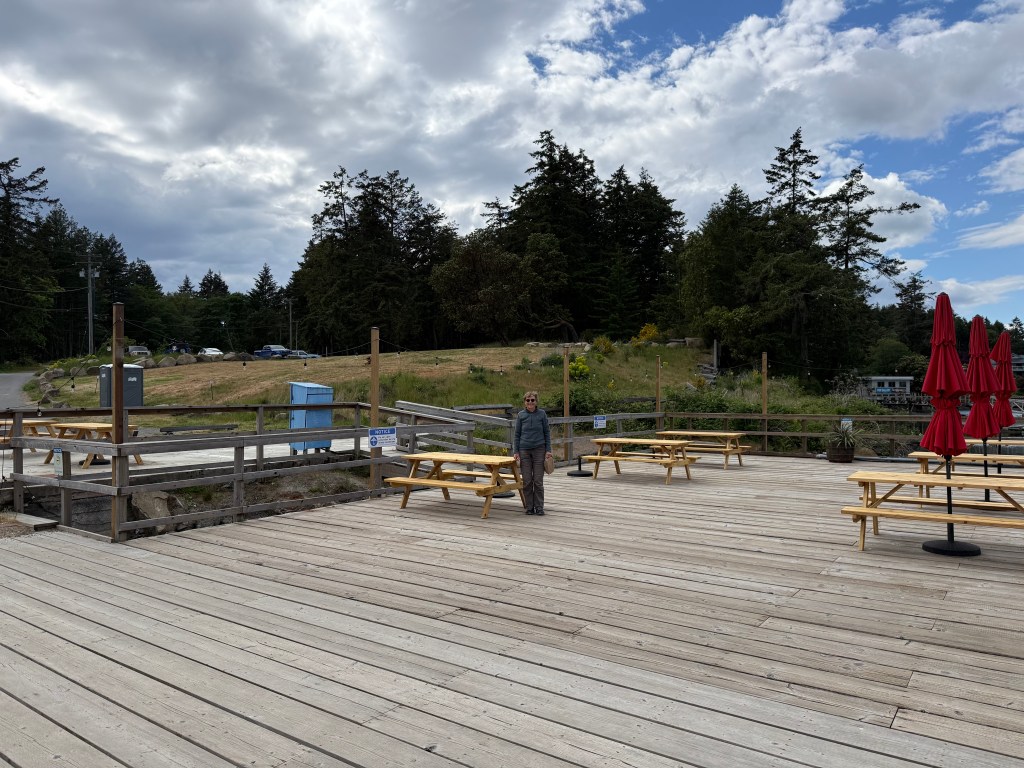
Our last visit to Silva Bay was with Robin and Mary aboard in 2010. We first anchored – to tend to misfortune with one of Palancar’s spinnakers, a story which I’ll not dwell on, and then moved to a dock. In 2017, the really nice restaurant that sat on a rise overlooking the Silva Bay Marina caught fire, burned to the ground, and has yet to be replaced. We learned of two issues delaying progress. The first is the discovery of middens on the plot. Really? The second is more plausible – the limited availability of water coupled with the zoning and water rights involving that parcel. The group that’s trying to rebuild has spent time and money perking up marina docks and other infrastructure and assures the public that it’s just a matter of time before a new restaurant will appear. We are not holding our breath. The photo of Jane below standing on a newish part of the shoreward dock is of the lonely and bare hillside.
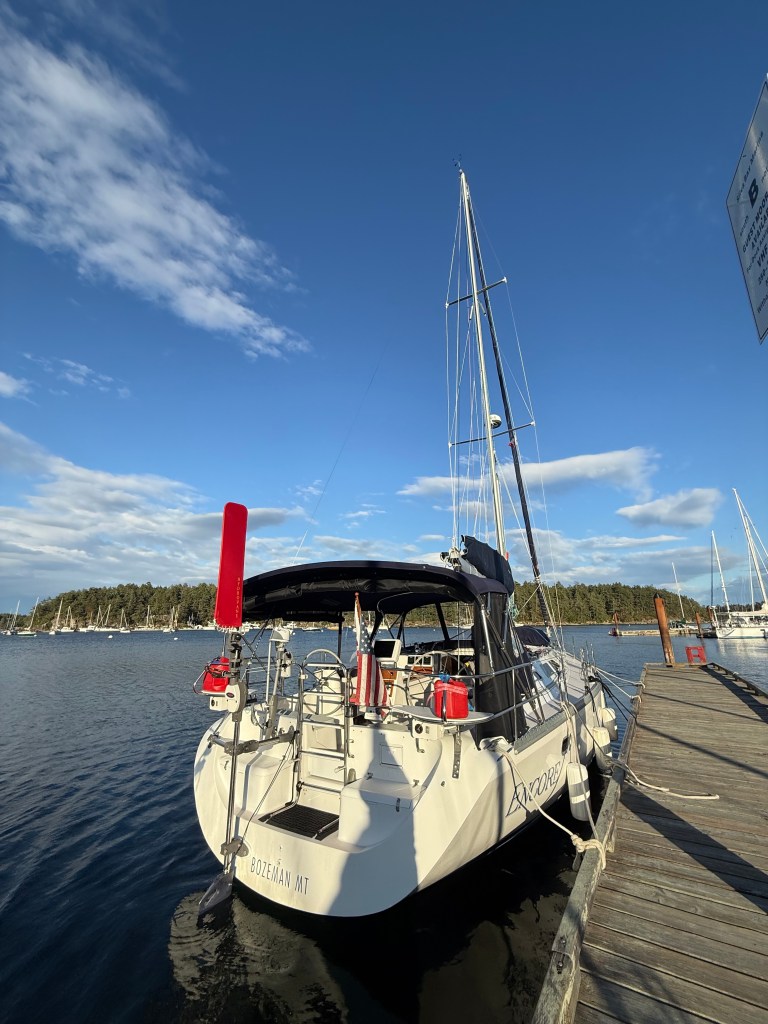
Silva Bay is a beautiful setting as captured in this picture of Encore on the “B” dock hammerhead.
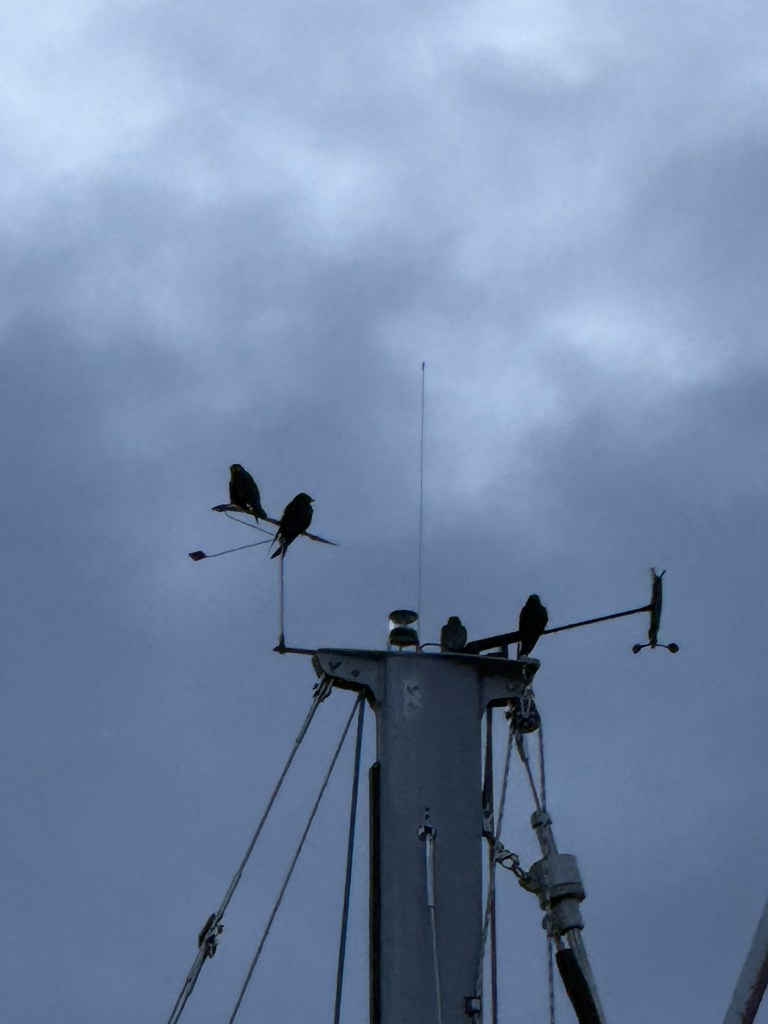
Several Purple Martins were about early the next morning as we endeavored to make the most of a strong ebb tide on our way to Montague Harbor.
5.14.26 – Friday
Some sailing days carry more adventure than others. Our Yanmar’s alternator did not start recharging the battery banks when I started the engine a 0545am, something that normally happens without a fuss. That Balmar component and its two related Balmar regulators had been black boxes to me and were front and center to provide me an educational opportunity. Poring over the well-written alternator and primary regulator manuals was quite helpful as I began poking around with a voltage tester. I noted a 360 (local to home) area code phone number in the regulator manual and pessimistically gave it a try. To my complete shock, a young man by the name of Chris answered his phone in Marysville at 0710am! We talked through the indications, and he provided some recommendations to determine if the problem lay with the regulator, the alternator, or the wiring between the two which I said I’d undertake and get back to him. The wiring connections appeared fine, so I was left with the belief that I needed a new alternator. After talking with my main on-island electrician and one more call to Marysville, I was eyeballing a plug connector that supplies a variable field current to the alternator. In trying to pry it apart, I discovered that it was mostly undone all by itself. I jammed the two plug ends together, started the engine again, and batteries started charging. Problem solved!
Soon after departing Silva Bay, we turned right to fly through Gabriola Passage between Valdes and Gabriola Islands. This is the northern most entrance into the Canadian Gulf Islands from the Strait of Georgia aside from the usual Dodd Narrows south of Nanaimo, and it was a fun and zippy ride for Jane steering Encore at 10.7kts at the peak! Anticipating, with appropriate skepticism, the marine forecast for westerly winds across the gulf islands, we were hoping for a nice broad reach coupled with the southerly ebb and were happily not disappointed. Four hours after anchoring, the gusty westerlies led us to consider shifting our anchorage to a more protected one inside Montague Harbor and Winstanley Point to the west. Glad we did for two reasons. Around 7pm that evening, the only Orca we’d spotted the entire trip announced its presence venting a couple of times some 350-400 yards north. The next venting was quite close aboard coming from the opposite direction south of us! Quite a big Orca it was!
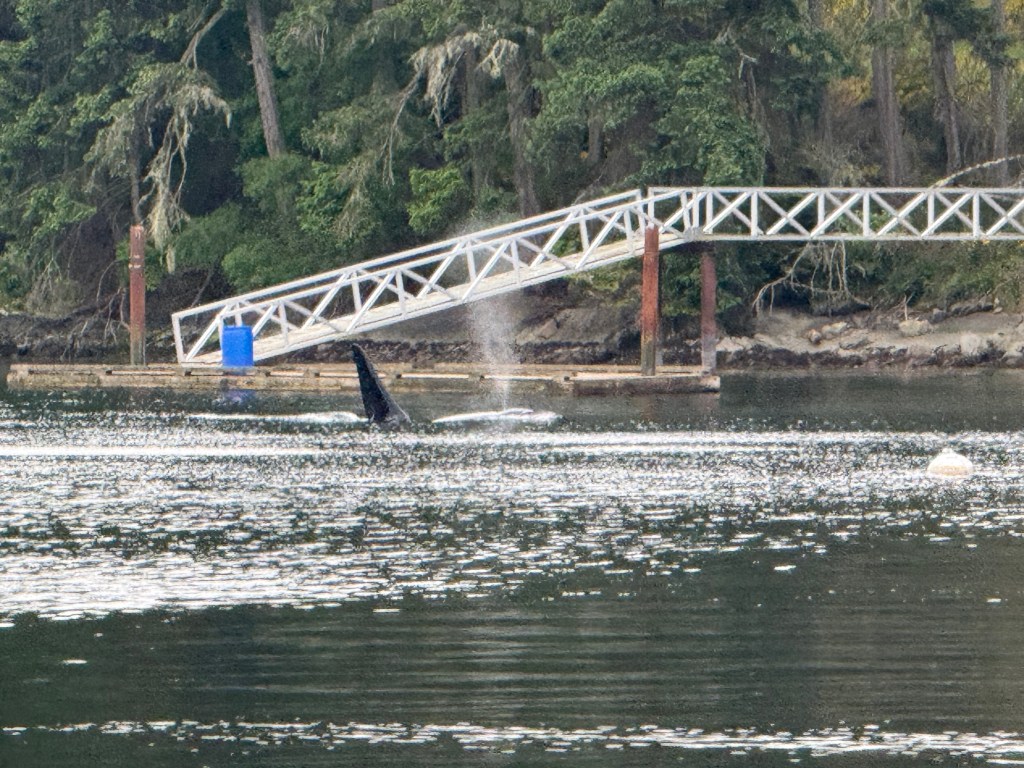
Here is a second and interesting video link. Watch the huge dorsal fin flop to port just as the guy/gal submerges. All I can imagine is that it was laughing having scared the pants off four nested cruisers moored just off its path to the left of the dock visible above.
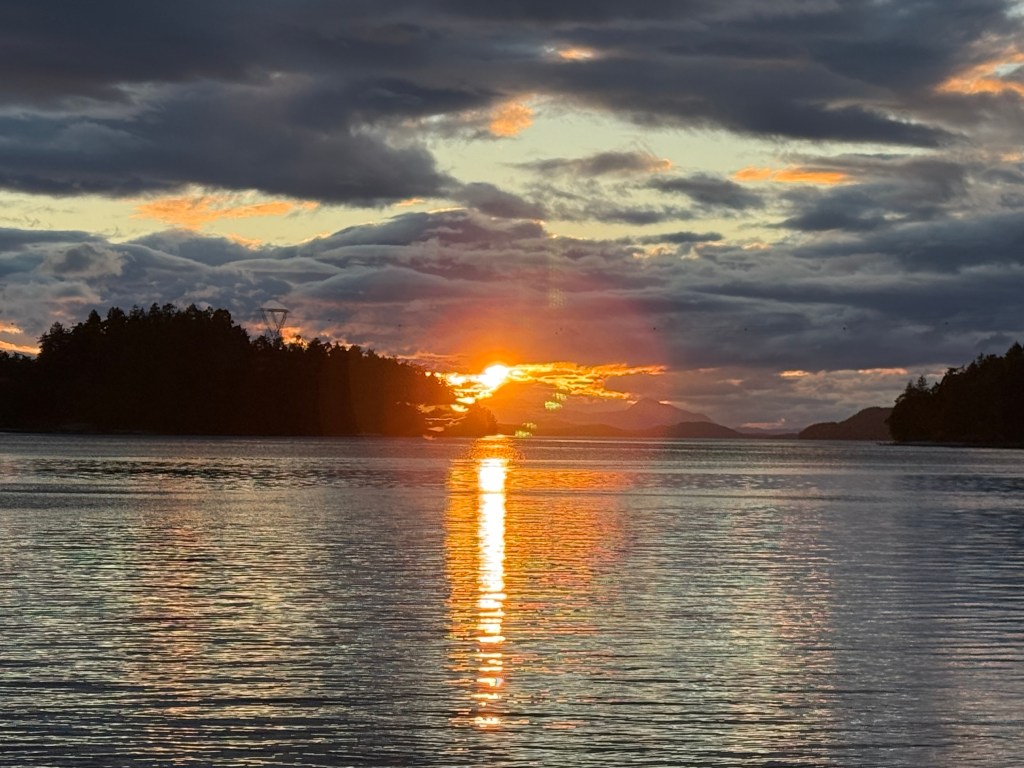
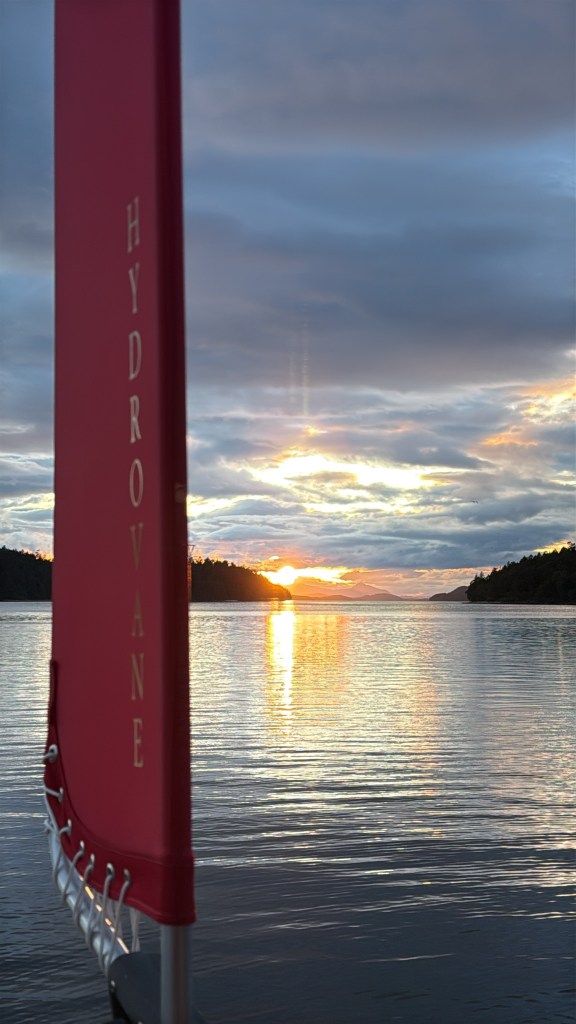
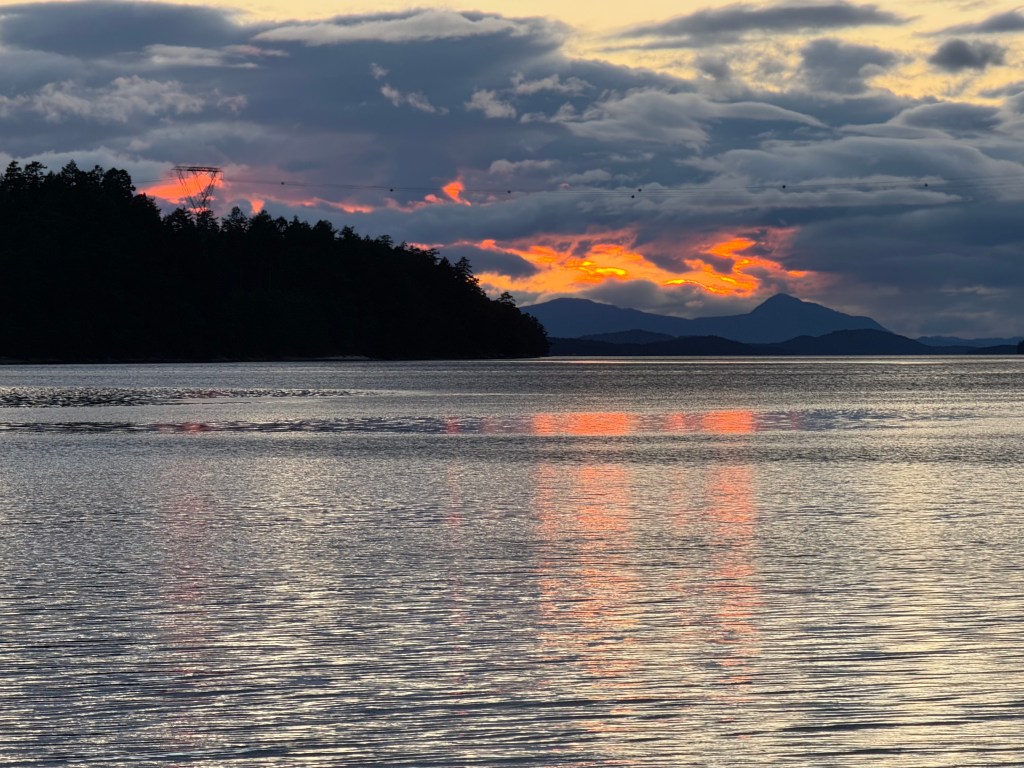
We have seen some remarkable sunsets in the vicinity of Montague Harbor in years past, and this trip blessed us with another one.
5.15.26 – Saturday
After an expected rodeo crossing Haro Strait from the Gulf Islands with respectable west winds revving up against an equally strong westerly ebb tide, we painlessly checked back into the United States using the CBP Roam app while underway and moored to refuel at Friday Harbor. At $226 for 30 gallons of diesel, that refueling took top honors not in terms of gallons but certainly in cost. Thankfully, Encore is a sloop with a miserly fuel diet.
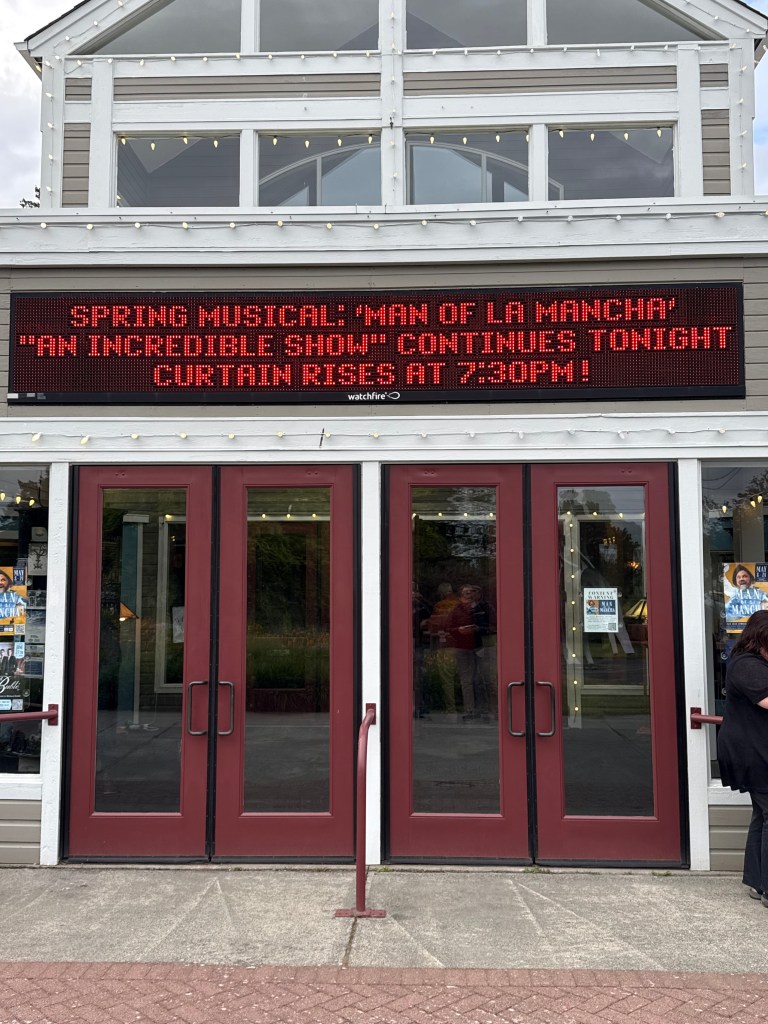
Without a doubt, the best part of our stay in Friday Harbor – the first since 2015 – was watching The Man Of Lamancha, the spring musical put on by the San Juan Community Theater. For those who’ve never seen this show as we hadn’t, put it on your list ASAP (https://en.wikipedia.org/wiki/Man_of_La_Mancha_(film)). There is much about this story that a lifetime of snippets doesn’t remotely satisfy. You will not be disappointed. Our friend from Scouting Days, Jean Wilson, played a supporting role. Who knew she had such a voice and one backed by a music degree from long ago!
5.16.26 – Sunday – the final leg home
It’s a long way from Friday Harbor to Eagle Harbor, 67nm to be exact. This was not our longest trip, which, at 70nm, was from Port McNeill to Thurston Bay at the junction of Johnstone Strait and Discovery Passage north of Campbell River. It just shy of 12 hours nonetheless.
Most sailors of smaller, slower boats who ply the Puget Sound know the tide game pretty well and are particularly alert for the wind against tide factor that can arise making passage both very slow and similarly uncomfortable. We had a taste of that off Point Wilson at Port Townsend but after an especially satisfying crossing of Rosario Strait on a broad reach with beam seas under Hydrovane’s control having rocketed through Cattle Pass between San Juan and Lopez Islands at 13.4kts on an ebb. That set us up for a fast crossing … only to meet the large ebb tide still-disgorging from Admiralty Inlet into the east end of the Strait of Juan de Fuca … and into 15kt westerly winds. Dang! At fully an hour and a half, it was our longest and most lively rodeo of the entire trip. This video doesn’t do it justice.
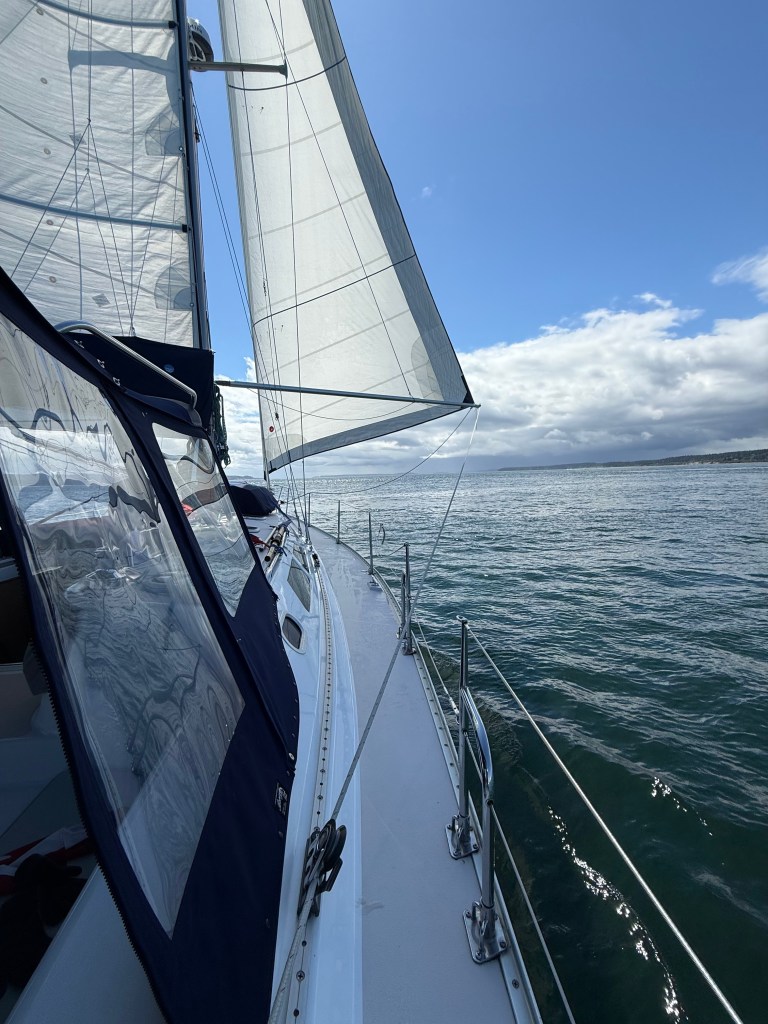
As all tides shift, the flood began as we were working around Marrowstone Point giving us several hours of following wind and seas. It enabled us to explore further the use of our new whisker pole and confirm both a better routing of the jib sheets when the pole is in use and how best to route a downhaul line should winds become gusty. It also allowed testing the Hydrovane sailing pretty much dead downwind, and it worked quite well!
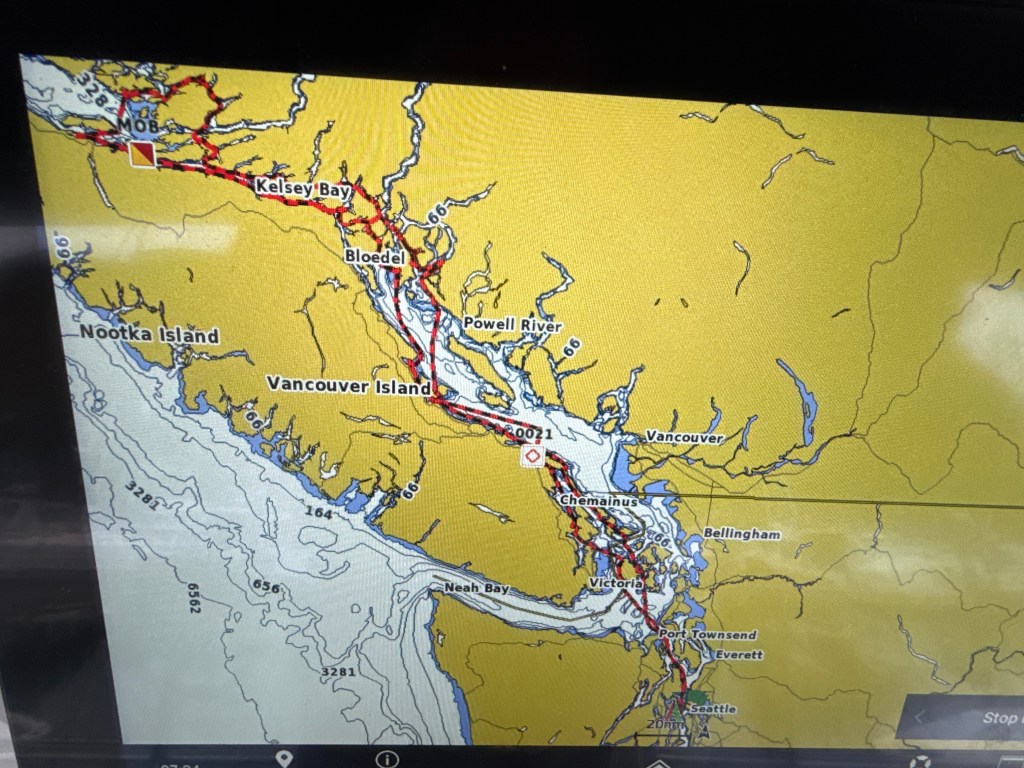
The picture below, taken of our Garmin 1243 chart plotter, provides the track of our entire three and a half week voyage. Sobering to realize that the entire journey was the distance to Ketchikan, Alaska!
Vital Trip Statistics:
Miles traversed in 21 days of underway time: 705nm
Average miles each underway day: 37
Total engine hours: 95
Average engine hours each underway day: 4.7 (We enjoyed several sailing-only hours!)
Engine efficiency (a): 0.7 gallon per hour Engine efficiency (b): 7.4 miles per hour Engine efficiency (c): 10.6 miles per gallon
Moorage fees – total: $320
Fuel costs – total: $460
Total cost, less provisioning, for three weeks underway: $780


What an adventure! I wish I understood more about the technical aspects of sailing, but it’s clear that you do and you’re enjoying learning more. So cool! I love seeing the pictures you take.
LikeLike